
World History Atlas
Screenshots
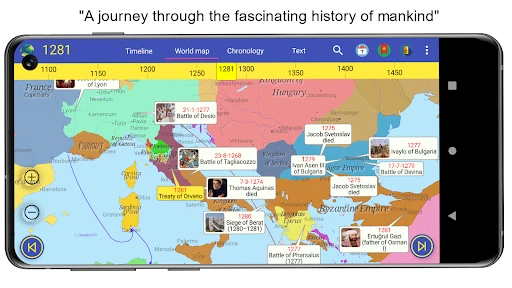

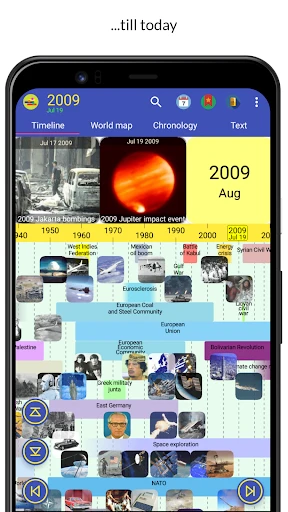
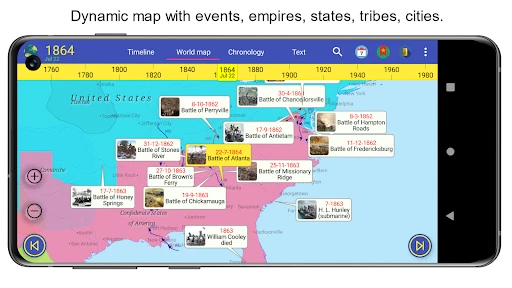

Description
About World History Atlas Features - A Visual Gateway to the Past
World History Atlas is a comprehensive mobile application designed to transform historical learning and exploration into an intuitive visual experience. It serves as a dynamic digital atlas, mapping the vast timeline of human civilization through interactive maps, timelines, and rich encyclopedic entries. The app bridges the gap between complex historical data and user-friendly understanding, allowing anyone from students to history enthusiasts to navigate the interconnected stories of empires, cultures, and events that have shaped our world. By presenting history geographically and chronologically, it provides context and clarity, turning abstract dates and names into a tangible, explorable journey across time and space.
Chapter 1: Function
The core functionality of World History Atlas centers on interactive visualization and structured exploration. Its primary tool is a global map that changes according to selected time periods, revealing the borders, cities, and major powers of any given era from ancient to modern times. Users can scroll through a central timeline to jump to specific centuries or events, with the map updating dynamically. Each historical entity, be it the Roman Empire or the Silk Road, is accompanied by concise, authoritative summaries. The app includes detailed thematic maps on topics like trade routes, military campaigns, and cultural diffusion. Search and bookmark functions allow for quick access to specific interests, while comparison tools enable side-by-side analysis of different regions or periods. Essentially, it functions as a portable, layered historical globe and reference guide.
Chapter 2: Value
The value proposition of World History Atlas lies in its unique ability to synthesize and spatialize historical information, offering key advantages over traditional textbooks or static maps. Its foremost value is enhanced comprehension; by visualizing the spatial dimension of history, users immediately grasp how geography influenced events, understanding why empires rose where they did and how interactions occurred. This spatial context is irreplaceable for deep learning. Secondly, it offers unparalleled connectivity, illustrating the links between disparate events and cultures, fostering a holistic view of world history rather than isolated facts. A major advantage is its efficiency as a research and study aid, saving significant time that would be spent cross-referencing multiple sources. The app's content, curated from reputable historical scholarship, ensures reliability. Furthermore, its intuitive design lowers the barrier to entry, making complex history accessible and engaging for a broad audience. It transforms passive reading into active discovery, encouraging exploratory learning. This combination of authoritative content, innovative visualization, and user-centric design positions the app as a valuable tool for education, professional reference, and personal enrichment, effectively making the user an active navigator of the past.
Chapter 3: Scenarios
World History Atlas primarily serves students, educators, writers, and general history enthusiasts. For high school and university students studying world history, geography, or social sciences, the app is an ideal companion for understanding course material, preparing for exams, and completing research projects. Teachers can use it as a dynamic presentation tool in classrooms to illustrate historical changes vividly. Authors, journalists, and content creators researching historical contexts for their work will find it an efficient fact-checking and inspiration tool. Casual users with an interest in history, perhaps planning a visit to a historical site or delving into their heritage, can use the app to explore the relevant historical layers of a location. Everyday use cases include a student tracing the expansion of the Mongol Empire across Asia, a teacher showing the changing European borders after World War I during a lesson, a novelist verifying the historical states existing in 12th-century Anatolia for a book setting, or a traveler using the app to understand the ancient civilizations that once flourished around the Mediterranean before a trip. It seamlessly integrates into both formal educational settings and personal, curiosity-driven exploration.
Uninstall Instructions
For step-by-step guidance on how to safely remove this application from your device, please refer to our 《Uninstall Instructions》 document.
Pros
- interactive timelines overlay events with maps
- offline access to all historical maps and articles
- side-by-side comparison of different empire borders
- scholar-verified citations for each entry
- minimalist interface avoids cluttered information
Cons
- requires large storage for high-resolution map packs
- no collaborative or user-generated content features
- limited audio or video multimedia materials
- steep learning curve for custom timeline creation
- subscription needed for specialized niche topics
Frequently Asked Questions
What is World History Atlas and what does it do?
World History Atlas is an educational reference app in the category of interactive maps and timelines. Its core function is to provide a visual, chronological exploration of global history. It positions itself as a digital atlas for students, educators, and history enthusiasts, offering detailed historical maps, timelines of events, and summaries of civilizations. The app allows users to navigate through different eras and regions to see geopolitical changes and key historical milestones.
Is World History Atlas free to use or does it have in-app purchases?
World History Atlas operates on a freemium model. The app can be downloaded and used for free with access to basic maps and timelines. For advanced features—such as in-depth articles, high-resolution maps, offline access, and specialized content packs (e.g., 'Ancient Civilizations' or 'Modern Conflicts')—it offers one-time purchases or a subscription. There are no ads in the free version, and no additional physical equipment is required beyond a compatible device.
On which devices and operating systems is the app available?
World History Atlas is available on iOS (iPhone/iPad, requiring iOS 14.0 or later) and Android (version 8.0 or later) mobile devices. It is also offered as a desktop-friendly web application accessible via major browsers. The app is optimized for both phones and tablets, with adaptive interfaces. It does not require special permissions beyond standard storage for offline downloads and is designed for general audiences, including students from middle school level upwards.
How does the interactive timeline feature work?
The interactive timeline is a core technical feature. Users can drag a slider or select a specific century to instantly update the world map, showing political borders, major empires, and significant events for that period. Tapping on map regions or timeline entries reveals concise event descriptions, cultural details, and figures. The feature uses vector-based maps for smooth zooming and panning, and data is curated from established historical sources, with periodic updates for accuracy.
Can I use the maps and content offline for study or teaching?
Yes, offline use is supported but requires prior action. Users must download specific map packs or era modules while connected to the internet. These downloaded contents—including maps, timelines, and articles—are then accessible without a connection. If a requested region or era hasn't been downloaded, the app will prompt you to go online. For any technical issues with downloads or content accuracy, support is provided via in-app help and email, with detailed FAQs on the developer's website.
App Info
Technical Info
Recommended For You

CCW – Concealed Carry 50 State
Books & Reference

WhenToWork Employee Scheduling
Business

Marvel Unlimited
Comics

Comickey - AI Comic Maker
Comics

Visible mobile
Communication

네이버 - NAVER
Books & Reference

Public Storage
Business

TCA Plus (TCA 2024)
Books & Reference

UPS
Business

Selfie Camera - Photo Effects
Beauty

Lezhin Comics -การ์ตูนและนิยาย
Comics

inCarDoc Pro | OBD2
Auto & Vehicles

Tor Browser
Communication

PayPal Business
Business

SpanishDictionary.com Learning
Books & Reference

Zello PTT Walkie Talkie
Communication

Resume Builder - CV Maker
Business

Booksy Biz: For Businesses
Beauty

Perfect Viewer Donation
Comics

Infinite Painter
Art & Design